Open the free app
Free · Private · No account

Pregnancy test calculator

This pregnancy test calculator works out the earliest day a home test can detect pregnancy — and the day its answer becomes reliable — from your last period, your ovulation date, the date you had sex, or the day your period is due.

When can I take a pregnancy test?

Count from the first day of one period to the first day of the next. 28 is average.
From an ovulation test, charting, or your best estimate.
Use the earliest relevant date if there was more than one.

Guidance follows the standard health-service advice: a home test is reliable from the first day of a missed period, or at least 21 days after unprotected sex if you do not know your cycle.

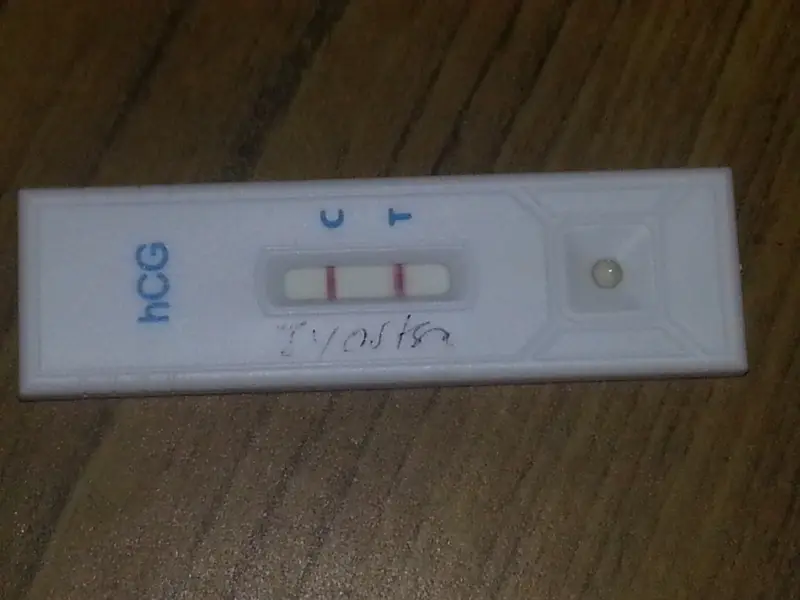
A home urine pregnancy test showing a positive result, resting on a surface

Why the date matters more than the test

Every home pregnancy test looks for the same hormone, hCG — and hCG only starts rising after implantation, which happens 6 to 12 days after ovulation. Test before enough hCG has built up and even a genuinely pregnant person gets a negative. The brand on the box matters far less than the day you use it.

The two-week wait, mapped

Ovulation → implantation (6–12 days) → hCG rise (roughly doubling every two days) → a line on a test. Our DPO calculator walks through what is happening on each of those days.

Four ways in — use the date you actually know

Most calculators force you through the last-period method. This pregnancy test calculator accepts any of the four starting points people genuinely have.

🗓️

Last period

The standard method. Enter the first day of your last period and your usual cycle length; the calculator estimates ovulation, your missed-period day, and all three test dates.

🌡️

Ovulation date

The most precise method if you tracked it. Test dates are counted directly from ovulation: earliest at 12 days past ovulation, reliable at 14.

💞

Date of sex

For when the cycle is a mystery. Because sperm can survive up to five days, the dependable date is 21 days after sex — the calculator shows the optimistic earliest date too, clearly labelled.

⏰

Period due date

Already counting down to a due period? Work backwards: a sensitive test gets its first real chance about four days before the period is due.

How the dates are worked out

The maths behind this calculator is the same date arithmetic midwives use, with the assumptions stated openly. Ovulation is estimated at 14 days before the next period — so in a 28-day cycle it falls on day 14, and in a 32-day cycle on day 18. After ovulation, a fertilised egg takes six to twelve days to implant in the uterus; a widely cited study of early pregnancies (Wilcox and colleagues, published in the New England Journal of Medicine) found most implantations cluster between days 8 and 10. Only once implantation happens does the hormone hCG begin entering the bloodstream and urine, roughly doubling every two days in the earliest weeks.

Put those three facts together and the test dates follow. A sensitive early test needs hCG to reach roughly 10–25 mIU/mL in urine. For most people that threshold arrives around 12 days past ovulation at the very earliest — a few days before a missed period. By the first day of a missed period (about 14 days past ovulation), hCG has had time to rise in nearly every pregnancy, which is why health services describe tests as reliable from that day. And if the first test is negative but the period still has not come, the standard advice is to test again three days later, because a late ovulation is the most common reason for a confusing result.

A worked example

Say your last period started on 1 November and your cycles run 28 days. Ovulation is estimated on 15 November. Implantation could happen between 21 and 27 November. The calculator gives 27 November as the earliest sensible test date, 29 November — the day your period is due and does not come — as the reliable date, and 2 December as the retest date if the first answer is negative. If a test turns positive, the same dates imply a due date of 8 August the following year. Every one of those numbers comes from the date rules above, not from a black box.

What this calculator cannot do

It cannot read a test strip, interpret a faint line, or tell you whether you are pregnant — and you should be suspicious of any app that claims it can from a photograph. It also cannot allow for cycles that break their own pattern: illness, stress, travel and coming off hormonal contraception can all move ovulation by a week or more, and when ovulation moves, every date derived from it moves too. That is why the results always pair the hopeful date with the reliable one.
The rest of the toolkit

Each calculator below answers one question properly, with the working shown.

Reading your result: what each date asks of you

The three dates are a small decision system. Before the earliest date, testing spends money to learn nothing — even a perfect test cannot detect a hormone that has not arrived. Between the earliest and reliable dates, testing is a legitimate choice with a known price: a positive is trustworthy, a negative is provisional, and first-morning urine is non-negotiable. On the reliable date, the result deserves belief in both directions, and the remaining ambiguity moves to the retest date: negative with no period means the calendar was probably wrong, not the test. People who plan the whole sequence in advance — earliest if I must, reliable to judge, retest if needed — consistently report an easier wait than people who improvise each morning. The TestDay app exists to hold that plan for you: enter a cycle once, and the countdown carries all three dates.

Why not just test every day?

Because daily testing in the early window mostly manufactures ambiguity. hCG roughly doubles every two days, so consecutive-day tests often look identical — and 'identical' reads as 'not working', which reads as anxiety. Alternate days show real change at half the cost. There is also a subtler trap: very early positives include pregnancies that will end before the missed period (early losses that, untested, would have arrived as an ordinary period). Knowing about them helps some people and burdens others. Neither choice is wrong; the calculator's job is to make sure the choice is informed — which is why the earliest date is always labelled with what a negative there does and does not mean.

Save your test day in the free app

The TestDay app keeps your countdown, your cycle diary and every calculator on your phone — private, offline, no account.

Open the free app →
Free · No account · Your data stays on your device

Pregnancy test calculator questions

What does a pregnancy test calculator actually calculate?

It works out the dates that matter when you are waiting to test: the earliest day a sensitive home test has a realistic chance of detecting pregnancy, the day a result becomes reliable (the first day of a missed period), and the date to test again if the first result is negative and your period still has not arrived. It cannot tell you whether you are pregnant — only a test can do that.

Which date should I enter if I only know one thing about my cycle?

Use whichever mode matches what you know. If you know the first day of your last period, the last-period mode is the standard one clinics use. If you tracked ovulation with tests or temperature, the ovulation mode is more precise. If all you know is a date of unprotected sex, use that mode and trust the 21-day date it gives you — the earlier date in that mode only works if sex happened to fall on ovulation day itself.

Why does the calculator give me three different test dates?

Because 'when can I test?' has three honest answers. There is an earliest date, when a very sensitive test might work but often does not yet; a reliable date, when a standard test is accurate for almost everyone; and a retest date, for the common situation where the first test is negative but the period still does not come. Showing only one date would pretend the biology is tidier than it is.

Can this calculator work out my due date as well?

Yes — in last-period and ovulation modes the result includes an estimated due date, calculated the standard way: 280 days from the last period, or 266 days from conception. The dedicated due date calculator adds conception, IVF and ultrasound modes if you need them.

Is the pregnancy test calculator free, and do I need an account?

It is completely free and there is no account. The calculator runs in your browser; the dates you type are not sent anywhere or stored. The optional TestDay app keeps a countdown and a cycle diary on your device only, under the same rule.

My cycle is irregular. Which date should I trust?

Irregular cycles mean ovulation day moves, so the earliest dates become guesses. The calculator includes an irregular-cycle fallback: if your period has not arrived by 36 days after your last period started, test then regardless of when you think you ovulated. If that test is negative and your period still does not come within another week, a clinician can help work out what is happening.

For information only. TestDay's calculators estimate dates from average cycle biology. They are not a diagnosis or medical advice and cannot confirm or rule out a pregnancy — only a pregnancy test and a clinician can do that. If you are worried about symptoms or a result, talk to a doctor, midwife or pharmacist.