Open the free app
Home › When to Take a Pregnancy Test

When to take a pregnancy test: the honest timeline

When to take a pregnancy test depends on one event you cannot see — implantation. This guide walks the full timeline from ovulation to a reliable result, then gives you your own dates.

Short version: a home test is reliable from the first day of a missed period. The earliest a sensitive test can work is about 12 days after ovulation (around four days before the period is due). If you do not know your cycle at all, test at least 21 days after unprotected sex. Negative before the reliable date? Retest three days after the missed period.
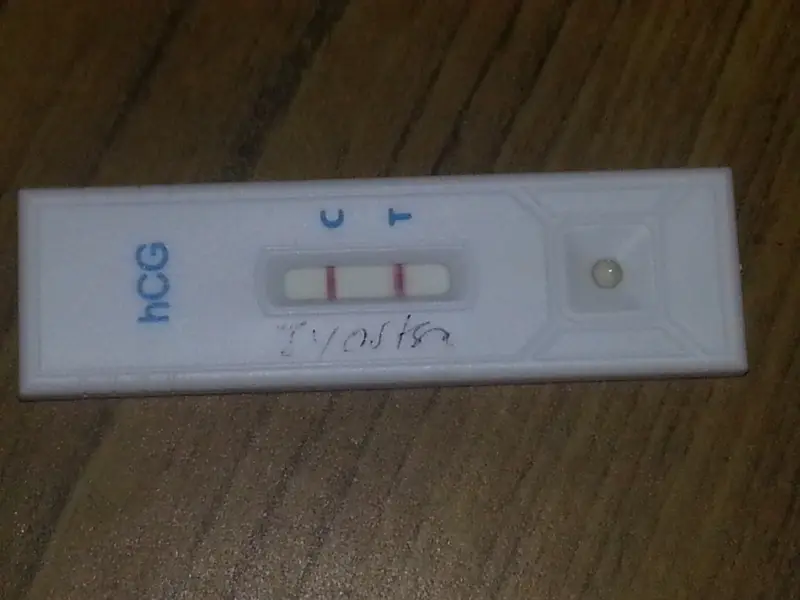
A home urine pregnancy test showing a positive result

The chain of events your test is waiting for

A pregnancy test does not detect sex, fertilisation or even, directly, pregnancy. It detects one hormone: human chorionic gonadotropin, hCG. And hCG is not produced by a fertilised egg floating in the fallopian tube — it is produced after the embryo implants in the wall of the uterus and the early placenta begins to form. That single fact explains every confusing test result you have ever heard about.

Here is the sequence, with typical timings. Ovulation releases an egg, which can be fertilised for about a day. The fertilised egg then spends several days travelling and dividing. Implantation — the embryo embedding in the uterine lining — happens between 6 and 12 days after ovulation, most often around days 8 to 10 according to the best-known study of the timing (Wilcox et al., New England Journal of Medicine, 1999). Only then does hCG start entering the blood, and a little later the urine, roughly doubling every two days at first.

Now place a test on that timeline. A sensitive early test needs urine hCG of roughly 10–25 mIU/mL. On the fastest realistic path — implantation on day 8, brisk doubling — that threshold can arrive around day 12 after ovulation. On a slower path — implantation on day 11 or 12 — the same threshold may not arrive until day 15 or 16, after the period was due. Both paths are normal pregnancies. That spread is the entire reason “when to take a pregnancy test” has a careful answer instead of a single date.

The three dates that matter

The earliest date (about 12 DPO). This is the first day a positive is possible, not the day it is likely. Plenty of pregnant people test negative on this date and positive three days later. Test then if you accept that a negative settles nothing. The reliable date (the missed period). By the first day a period does not arrive, implantation has happened in effectively every pregnancy and hCG has had days to climb. This is the date health services quote, and the first date on which a negative deserves to be believed. The retest date (three days later). If the reliable-date test is negative and the period still has not come, the likeliest story is late ovulation — your whole timeline quietly shifted. Three more days covers most of that shift; a week after the missed period, a negative is dependable.

What about testing before a missed period?

Early tests are marketed hard on the days before a missed period, and they are not lying exactly — they are describing their best case. A test that detects 10 mIU/mL, used by someone who implanted on day 8, can genuinely show a line four days early. But the same test used by someone who implanted on day 11 shows nothing, four days early or two. When you test before the missed period you are betting on your implantation day, which nobody can know in advance. If an early answer would change what you do — medication, alcohol, a medical procedure — testing early with first-morning urine is reasonable, as long as a negative is treated as “too soon to say” and followed up on the reliable date.

If you do not know your cycle

Plenty of people cannot name their last period or cycle length: irregular cycles, recent contraception changes, breastfeeding, or simply not tracking. The fallback rule used by health services is built for exactly this situation — test at least 21 days after the last unprotected sex. Twenty-one days is not arbitrary: it stacks the longest sperm survival (about five days) on top of the latest implantation (about twelve days after ovulation) plus a margin for hCG to rise. The sex-date mode of the calculator on this page applies that rule for you.

Getting the most accurate result from any test

Your dates, calculated

Everything above reduces to four inputs, depending on what you know. Run the calculator with your own dates — it returns the earliest, reliable and retest dates together, so you can see the whole window at once rather than fixating on a single day.

When can I take a pregnancy test?

Count from the first day of one period to the first day of the next. 28 is average.
From an ovulation test, charting, or your best estimate.
Use the earliest relevant date if there was more than one.
For information only. TestDay's calculators estimate dates from average cycle biology. They are not a diagnosis or medical advice and cannot confirm or rule out a pregnancy — only a pregnancy test and a clinician can do that. If you are worried about symptoms or a result, talk to a doctor, midwife or pharmacist.

Evening urine and the dilution problem

Concentration is the quiet variable in every early test. First-morning urine has sat in the bladder for hours, concentrating whatever hCG is present; urine produced after a day of drinking fluids can be several times more dilute, pushing a borderline level back below the test's threshold. This is why an early positive in the morning can be followed by an afternoon negative that means nothing. In the early window, test with the first urine of the day; after the missed period, concentration stops mattering for most tests. If you must test later in the day before your period is due, a hold of several hours without excessive fluids is the closest substitute.

Edge cases that move the dates

Fertility medication with hCG. Trigger shots contain hCG itself and can produce positive tests for up to about two weeks after injection — the opposite problem from this page's. If you used one, your clinic's scheduled blood test is the only clean answer. A recent pregnancy. After a birth, miscarriage or termination, hCG takes days to weeks to clear; a test in that window may be reading the previous pregnancy. Twins and multiples. hCG tends to run higher with more than one embryo, so positives can arrive a little earlier — but the overlap with singleton ranges is so wide that test timing and line darkness cannot tell you how many embryos there are. Only a scan can. Perimenopause. Slightly raised baseline hCG from the pituitary gland can, uncommonly, produce faint positives in the late forties and fifties — one reason confusing results at that age deserve a clinician's blood test rather than repeated home tests.

Digital tests: clearer words, same chemistry

Digital tests replace the line with a screen reading 'Pregnant' or 'Not Pregnant', and some estimate weeks since conception from hormone level. The clarity is real — no squinting, no evaporation-line debates — but the underlying detection is the same chemistry with similar thresholds, so a digital test is not more accurate on the earliest dates; some are slightly less sensitive than the best strip tests. The weeks indicator is a rough estimate from hCG concentration, which varies widely between pregnancies. Use digital for readability on or after the missed period; use sensitive strips, first-morning urine and patience for the early window.

When-to-test questions

When is the absolute earliest I can take a pregnancy test?

The earliest any test stands a chance is about 12 days after ovulation — roughly four days before a missed period with the most sensitive early tests. Before that, implantation may not even have happened yet, so there is no hCG to detect. Testing earlier than that is testing the calendar, not your body.

Why do health services say to wait for a missed period?

Because by the first day of a missed period, hCG has risen high enough in almost every pregnancy for a standard test to detect it. Testing on that date makes the answer trustworthy in both directions — a positive is a positive, and a negative is very likely a true negative. Earlier testing mostly manufactures ambiguous negatives.

I tested early and got a negative. Does that mean I am not pregnant?

No — an early negative is the single most common confusing result in this whole area. If you tested before your period was due, the honest reading is 'not yet detectable', not 'not pregnant'. Wait for the retest date the calculator gives you (three days after the missed period) and test again with first-morning urine.

Does the time of day I test really matter?

On the earliest dates, yes. First-morning urine is the most concentrated of the day, so it holds the most hCG per drop. Once you are a few days past a missed period it stops mattering — hCG is high enough to show up at any hour. Drinking a lot of fluid before an early test can dilute urine enough to matter.

How long after sex should I take a pregnancy test?

If you do not know when you ovulated, the dependable rule is at least 21 days after unprotected sex. That window covers the longest realistic chain: sperm surviving five days, then ovulation, implantation up to 12 days later, and a few days for hCG to rise. Testing at two weeks after sex is a common mistake — it can easily be a week too soon.

My period is late but the test is negative. What now?

Retest in three days. Late ovulation is the usual explanation: if you ovulated a week later than usual, your period and your reliable test date both move a week later too. If a second test a week after the missed period is still negative and there is still no period, that is worth a conversation with a clinician — especially if it happens more than once.

Save your test day in the free app

The TestDay app keeps your countdown, your cycle diary and every calculator on your phone — private, offline, no account.

Open the free app →
Free · No account · Your data stays on your device