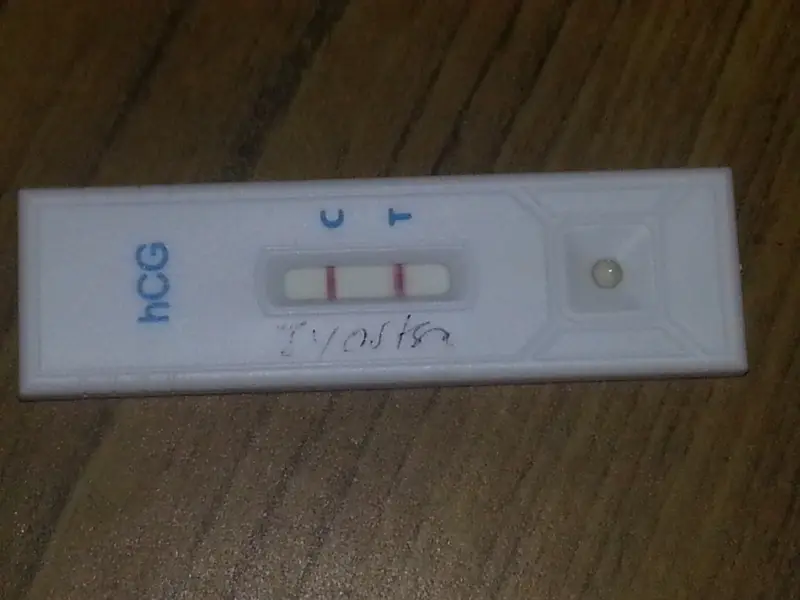
Cause 1: you tested before implantation finished (the big one)
A home test can only react to hCG, and hCG only exists after implantation. Implantation happens 6–12 days after ovulation. Test at 9 or 10 days past ovulation and there is a real chance implantation has literally not occurred yet — the test is not wrong about your urine; your urine simply contains nothing to detect. This is not a defective test or a defective body. It is a calendar problem, and it resolves itself: the same person, testing four days later, gets an unambiguous positive. Every “my test was negative, then positive” story you have heard is this cause, almost without exception.
Cause 2: ovulation was later than you think
Test dates are usually worked out from an assumed ovulation day, and ovulation is the most movable part of the cycle. Stress, illness, travel, disrupted sleep and ordinary randomness can push it back by days or a week. When ovulation moves, implantation, the missed period and the reliable test date all move with it — but the test you already took was scheduled by the old calendar. Someone who believes they are 14 DPO may really be 9 DPO, with a correctly negative test. This is why the guidance after a negative is always “retest in a few days” rather than “accept the answer”: the retest quietly corrects for the shifted ovulation.
Cause 3: diluted urine
Tests measure concentration, not total hormone. Early on, when hCG sits near the detection threshold, a large drink can dilute urine enough to push a borderline sample under the line. The effect disappears later — by a week past a missed period, hCG is high enough to survive any reasonable hydration — but for early tests it is a genuine cause, and the reason first-morning urine is the standard advice.
Cause 4: the test itself, or how it was used
Expired tests lose sensitivity. Tests stored in heat or humidity degrade. Reading outside the stated time window manufactures lines (evaporation marks) and occasionally hides real ones. Too little urine on the absorbent tip, or flooding a midstream test, can both invalidate a result. None of this is common with an in-date test used as directed, but it is worth one careful repeat with a fresh test before drawing conclusions from a surprising negative.
The rare causes, for completeness
The hook effect — hCG so high it saturates the test chemistry — is real but belongs to much later pregnancy or unusual conditions, not to the days around a missed period. Faulty batches exist but are rare and usually produce obviously broken results (no control line), which the instructions tell you to discard. Certain medical conditions affecting hormone production are rarer still. If your situation involves fertility treatment, previous ectopic pregnancy, or persistent absent periods with negative tests, skip the internet differential entirely and let a clinician work it through — that is what they are for.
The retest plan
After a negative you believe might be false, the schedule is simple. Retest three days after the missed period, with first-morning urine and a fresh, in-date test. If that is negative and your period arrives, the first answer was right. If it is negative and your period still has not come, test once more a full week after the missed period; by then, a negative is dependable for nearly everyone. And at any point, pain, bleeding or dizziness changes the situation from “wait and retest” to “get care now” — the box below is not decoration.
Symptoms, no period, negative test: the confusing triad
The situation that sends most people to this page is a combination: symptoms that feel like pregnancy, a period that has not arrived, and a test that says no. Worked through in order, the triad usually resolves itself. The symptoms are progesterone's, and progesterone is present because ovulation happened — but if ovulation happened late, its symptoms run late too, and the period is not late at all relative to the real ovulation day. The negative test, taken on the assumed schedule, was an early test in disguise. The retest plan below exists precisely for this: three days, then a week. If both retests are negative and the period still has not come, the question stops being about pregnancy tests at all — absent periods have their own list of causes (thyroid, prolactin, polycystic ovaries, weight change, stress, perimenopause), and that list belongs to a clinician.
False negative questions
What is the most common cause of a false negative pregnancy test?
Testing too early — before hCG has risen past the test's detection threshold. It accounts for the overwhelming majority of false negatives. Implantation may only have happened a day or two before the test, or may not have happened yet at all. The fix is unglamorous: wait, and retest on the reliable date.
Can I be pregnant even though the test was negative on the day my period was due?
Yes, though it is less common than an early-test false negative. Late ovulation is the usual reason: if you ovulated a week later than you assumed, then on the day you expected your period you were really only about 7 DPO — far too early. Retest in three days, and again a week after the missed period, before concluding.
What is the hook effect, and should I worry about it?
The hook effect is a rare phenomenon where extremely high hCG — usually much later in pregnancy, or with certain conditions — overwhelms a test and produces a false negative. It is not a plausible explanation for a negative in the first days around a missed period, when hCG is at its lowest. It belongs on the list for completeness, not near the top of anyone's worries.
Can diluted urine really cause a false negative?
Yes, in the early days. If you drink a large amount of fluid, urine hCG concentration falls, and a borderline level can drop under the threshold. This is precisely why first-morning urine is recommended for early testing — it is the most concentrated sample, giving the test the best chance.
How many negative tests should I take before I believe them?
Judge by dates, not by count. A negative on or after a week past your missed period — with correctly used, in-date tests — is dependable for almost everyone. Ten negatives before the reliable date prove less than one negative after it. If periods remain absent with negative tests over several weeks, that itself is a reason to see a clinician.
Could medication cause a false negative?
Most medications do not interfere with home tests. Fertility drugs containing hCG cause false positives, not negatives. Diuretics can contribute indirectly by diluting urine. Hormonal contraception does not mask a pregnancy on a test — if hCG is there, the test chemistry still reacts to it.