Open the free app
Home › How Early Can You Take a Pregnancy Test

How early can you take a pregnancy test, really?

How early can you take a pregnancy test is the most-searched question of the two-week wait — and the most over-promised. Here is the day-by-day reality, by days past ovulation.

Short version: the earliest a sensitive test can possibly work is about 10–12 days after ovulation — around four days before a missed period — and even then most pregnant people still test negative. Every day earlier than that trades accuracy for hope. The dependable answer remains the missed-period day.
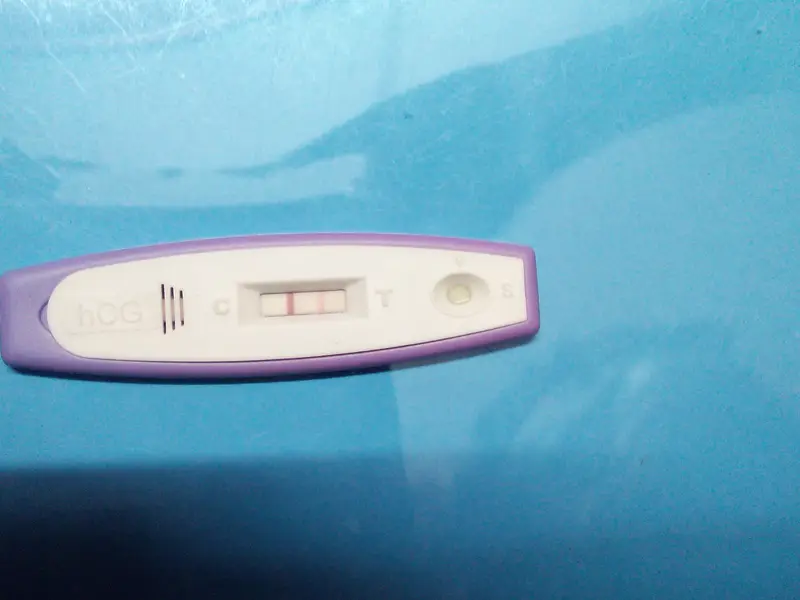
A cassette-style home pregnancy test with a clear control line and a much fainter test line — the classic early-testing result

That photograph is the early-testing experience in one image: a control line doing its job and a test line so faint it starts arguments. Faint lines are what hCG near the detection threshold looks like — which is exactly the territory this page is about. (A photo cannot be interpreted reliably, including this one; only a follow-up test on a later date settles what a faint line meant.)

The claim on the box vs. the biology

Early pregnancy tests advertise detection “up to six days before your missed period”. That phrase is built on the longest possible cycle maths: a missed period is counted from an assumed 28-day cycle, and “six days before” lands on about 8 days after ovulation — a day when implantation has frequently not finished, and sometimes not started. In the manufacturers' own fine print, the share of pregnancies detected that early is low. By four days before, a sensitive test catches a reasonable share. By the day of the missed period, it catches nearly all. The gradient between those points is not marketing — it is the implantation spread, and no brand escapes it.

Day by day: what is happening at each DPO

DPO means days past ovulation, and it is the only honest clock for early testing, because everything is timed from ovulation — not from your period, and not from the day you had sex. The condensed version: days 1–5, the egg (if fertilised) is travelling and dividing; no hCG exists. Days 6–12 are the implantation window, with days 8–10 the most common. hCG enters the blood as implantation proceeds and reaches urine a little behind. Around day 12, urine hCG crosses the threshold of a sensitive test in a growing share of pregnancies. Day 14 — the missed period — is when the share becomes nearly everyone. The full day-by-day table, with test guidance for each day, is on our DPO calculator page.

Why “how early” depends on implantation, not on the test

Two people can ovulate on the same day, use the same test on the same morning, and get opposite results — because one implanted on day 8 and the other on day 11. Implantation timing is the hidden variable in every early-testing story, including the dramatic ones online. The research most often cited (Wilcox et al., 1999) tracked pregnancies from ovulation and found implantation spread across days 6–12, concentrated at 8–10 — and also found that later implantation was associated with higher early loss, which is one more reason very early positives should be held gently until the missed-period date confirms them.

Early testing, done sensibly

If you are going to test early — and many people reasonably do — do it in the way that produces the least confusion. Start no earlier than 10 DPO, and treat 12 DPO as the first date with real information. Use the most sensitive test you have, with first-morning urine. Test every other day rather than daily, because hCG doubles roughly every 48 hours and a two-day gap makes change visible. Photograph results within the reading window if you want to compare them, and never compare a fresh test with one from hours ago — dried tests darken and mislead. Most importantly, decide in advance what each result will mean: a positive is a positive, but a negative before the missed period means “test again on the reliable date”, full stop.

When early testing is genuinely worth it

There are situations where the earliest possible answer changes decisions: starting or stopping a medication that is not recommended in pregnancy, an upcoming medical procedure or X-ray, fertility treatment where your clinic schedules blood tests by DPO, or simply a level of anxiety that waiting would make worse. In fertility care, clinics typically schedule a blood hCG around 9–14 days after a transfer or insemination precisely because that is when the number becomes meaningful. For everyone else, the missed-period test remains the best-value answer in the whole process: one test, one trustworthy result.

Check where today falls

Enter your ovulation date below and the calculator will tell you exactly which DPO today is, what is likely happening biologically, and whether testing today can tell you anything.

DPO calculator

Leave as today, or pick any date to see its DPO.
For information only. TestDay's calculators estimate dates from average cycle biology. They are not a diagnosis or medical advice and cannot confirm or rule out a pregnancy — only a pregnancy test and a clinician can do that. If you are worried about symptoms or a result, talk to a doctor, midwife or pharmacist.

A note on the earliest day of all: 8 DPO

Occasionally a test does turn positive at 8 DPO — the earliest implanters (about one in twelve pregnancies) plus a sensitive test plus concentrated urine can align. It is worth understanding why this page still anchors 'earliest sensible' at 10 DPO. A date on a calculator is advice to everyone, including the 90% whose implantation has not happened or whose hCG has not crossed any threshold by day 8: for them an 8 DPO test is a near-certain wasted strip and a day of false reassurance or false despair. Advice is set by the typical case, not the record books. If you test at 8 DPO anyway and see a line, believe the line (positives are rarely false) — and if you see nothing, you have learned nothing, which is exactly the point.

What '6 days sooner' claims actually rest on

Early-result packaging often promises an answer '6 days before your missed period'. Read the fine print and the claim narrows considerably: it typically means six days before the missed period equals five days before the expected period in a textbook 28-day cycle — and the detection rate at that distance, in the manufacturer's own study, is only a little better than half of pregnancies. The claim is not false; it is a best-case sensitivity figure presented as a schedule. The honest translation is the one this page is built on: at that distance you are buying a coin flip weighted by implantation luck, and the same test four days later is a different instrument entirely. If the early date matters to you, go in with the percentage in mind rather than the promise.

The sensitivity ladder

Tests differ mainly in the concentration of hCG they can detect, and the ladder has three rungs. Around 10 mIU/mL — the 'ultra-early' strips and a few premium brands: the only rung with any chance at 10–11 DPO, and the rung where indent and evaporation confusion is most common. Around 25 mIU/mL — most standard tests, including many supermarket own-brands: dependable from the missed period, marginal before it. 50 mIU/mL and above — some cheap bulk strips and older designs: fine a few days after a missed period, genuinely poor before it. The practical reading: brand matters less than rung, and rung matters less than date. A 25 mIU/mL test on the reliable date outperforms a 10 mIU/mL test four days early, in both accuracy and peace of mind.

Faint lines, stage by stage

A faint line is what 'just above threshold' looks like, so its meaning depends entirely on when it appears. At 10–11 DPO, a faint line is the expected appearance of an early positive — retest in two days and it should be clearly darker. At 13–14 DPO, faint is still common and usually meaningless variation in urine concentration. A line that stays faint across several days of testing, or fades, deserves a clinician's blood test rather than more home interpretation: hCG trends are a blood measurement, and a plateau or fall is information a professional should hold. And a 'line' that appears only after the reading window, on a dried test, is not a faint line at all — it is an evaporation mark, the most misread object in this entire subject. This site cannot interpret a photograph of your test; nobody online can, reliably. The follow-up test on a later date is the interpretation.

Early-testing questions

How early can a pregnancy test detect pregnancy before a missed period?

The most sensitive early tests can sometimes detect pregnancy about four days before a missed period — which corresponds to roughly 10–12 days after ovulation. 'Can' is doing heavy lifting in that sentence: it requires early implantation and a sensitive test. Five or six days before a missed period, even most pregnant people will test negative.

What does 10 mIU/mL sensitivity actually mean?

It is the lowest concentration of hCG in urine the test is designed to detect. Standard tests are usually around 25 mIU/mL; early tests claim 10 mIU/mL or lower. Lower is better for early testing, but no sensitivity helps before implantation — if hCG is not in your urine yet, the most sensitive test in the world reads negative.

Can a pregnancy test be positive at 7 DPO?

Effectively no. Implantation itself rarely begins before 6 DPO and most often happens at 8–10 DPO; hCG then needs a day or two to reach urine. A 'positive' at 7 DPO is almost always an evaporation line, an indent line misread, or a misremembered ovulation date. If you see something at 7 DPO, the right move is to retest at 12 DPO, not to conclude either way.

Why did my friend test positive at 9 DPO but mine is negative at 11?

Because implantation day varies. Implant at 7–8 DPO and a sensitive test can turn by 9–10 DPO; implant at 11 DPO and nothing can show until 13–14 DPO. Both are normal. Comparing DPO results between different people compares different implantation days, not different test quality.

Are blood tests earlier than urine tests?

Yes, slightly. A quantitative blood test can detect hCG a day or two before a urine test because it measures much lower concentrations directly in the blood. Blood tests need a clinic visit, though, and for most people waiting two days for a home test gives the same answer for free.

Should I test every day once I start testing early?

Daily testing mostly buys daily ambiguity: hCG roughly doubles every two days, so alternate-day testing shows change far more clearly and costs half as much. If you test early, test every other morning with first urine, and judge by the reliable date — the day of the missed period — not by the earliest faint result.

Save your test day in the free app

The TestDay app keeps your countdown, your cycle diary and every calculator on your phone — private, offline, no account.

Open the free app →
Free · No account · Your data stays on your device